Section 8
This section begins with using a single-slot cache for reading, which will help you to begin the problem set. Then, we’ll walk through a selection of our storage exercises, which are problems taken from prior exams. Also take the opportunity to ask questions about the problem set and class material.
Terminology: Blocks, slots, and addresses
A cache is a small amount of fast storage that helps speed up access to slower underlying storage. The underlying storage often has larger capacity than the cache, meaning that it can hold more total data. When discussing caches in general, we use these terms:
-
A block is a unit of data storage. Both the underlying storage and the cache are divided into blocks. In some caches, blocks have fixed size; in others, blocks have variable size. A cache determines its block size, though in some cases it will use a natural block size taken from the underlying storage.
-
Each block of underlying storage has an address. We represent addresses abstractly as integers, though in a specific cache, an address might be a memory address, an offset into a file, a disk position, or even a web page’s URL.
-
Each block in the cache is a slot. A slot can either be empty or full. An empty slot has no data, while a full slot contains a cached version of a specific block of underlying storage. A full slot therefore has an associated address, which is the address of that block on underlying storage.
File positions
Standard I/O caches are intended to speed up access to data read and written
from file descriptors, which are the Unix representation of data
streams and random-access files. System calls like read and
write perform the reading and writing. Standard I/O caches can
improve performance by reducing the number of system calls performed.
Besides transferring data from or to a file, read and write also affect
the file descriptor’s file position. This is a numeric byte offset
representing the current position in the file.1 A read or write system
call starts reading or writing at the current file position, and then
increments the file position by the number of characters processed.
The kernel maintains all file positions. User processes can only observe or
affect a file position by making a system call, such as read, write, or
lseek. (lseek system call modifies the file position without
transferring data, and is required to read or write a file out of sequential
order.)
As a result, successive calls to read progress sequentially through the
file. You can see this in the following example.
-
Right before executing
read(fd, buf, 1)on a just-opened file (the file position is shown in red):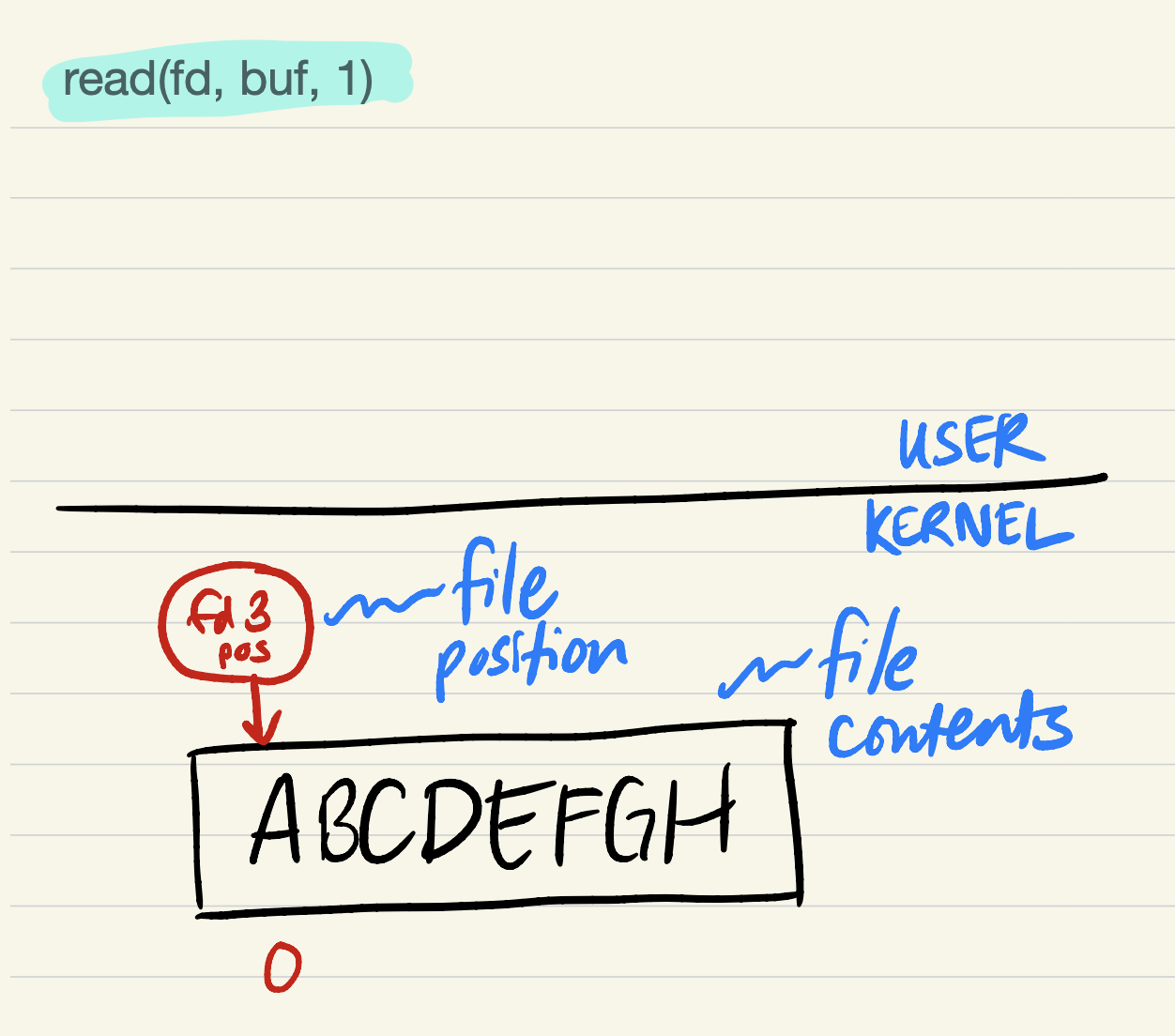
-
After
read(fd, buf, 1):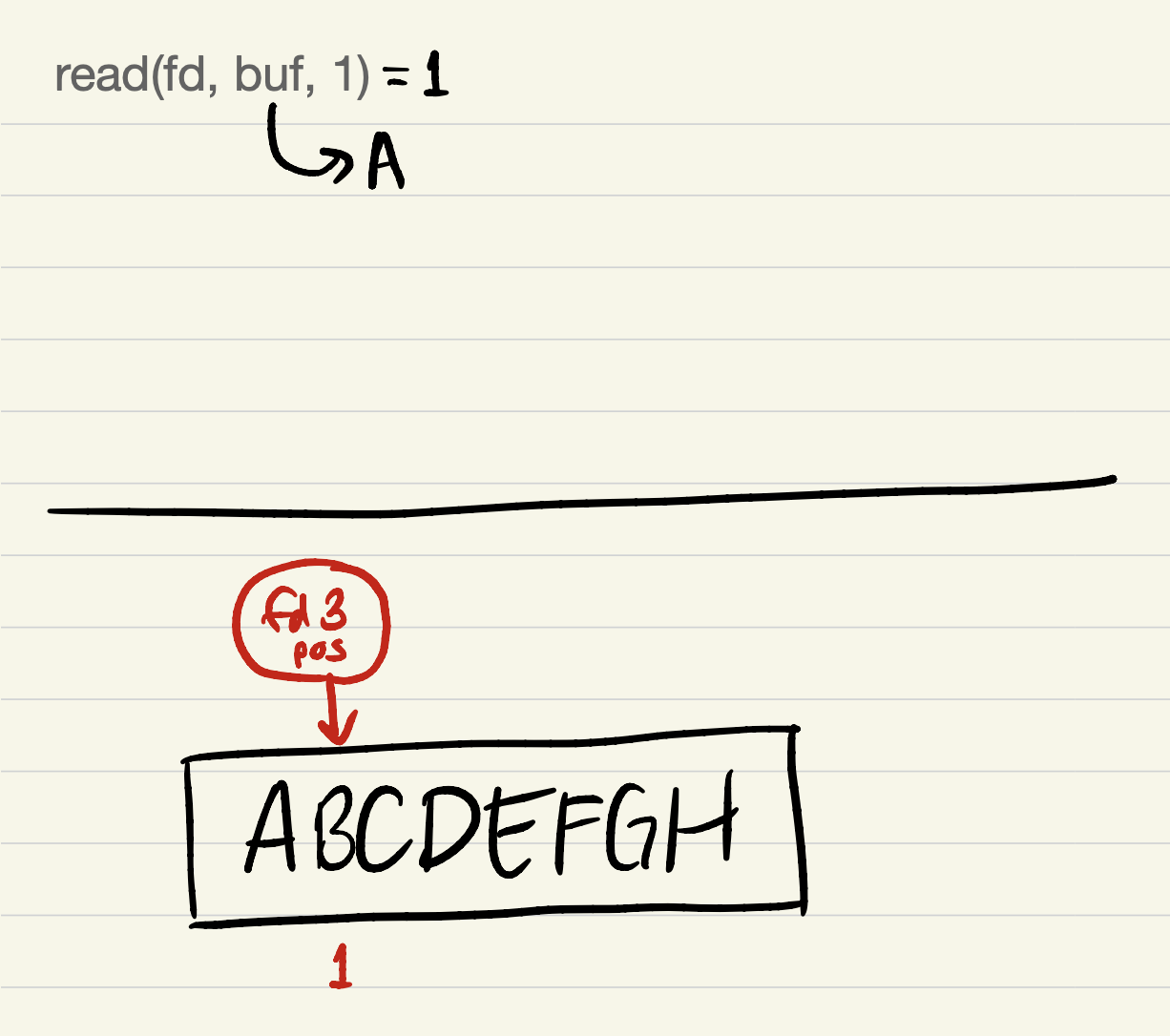
-
After
read(fd, buf, 2):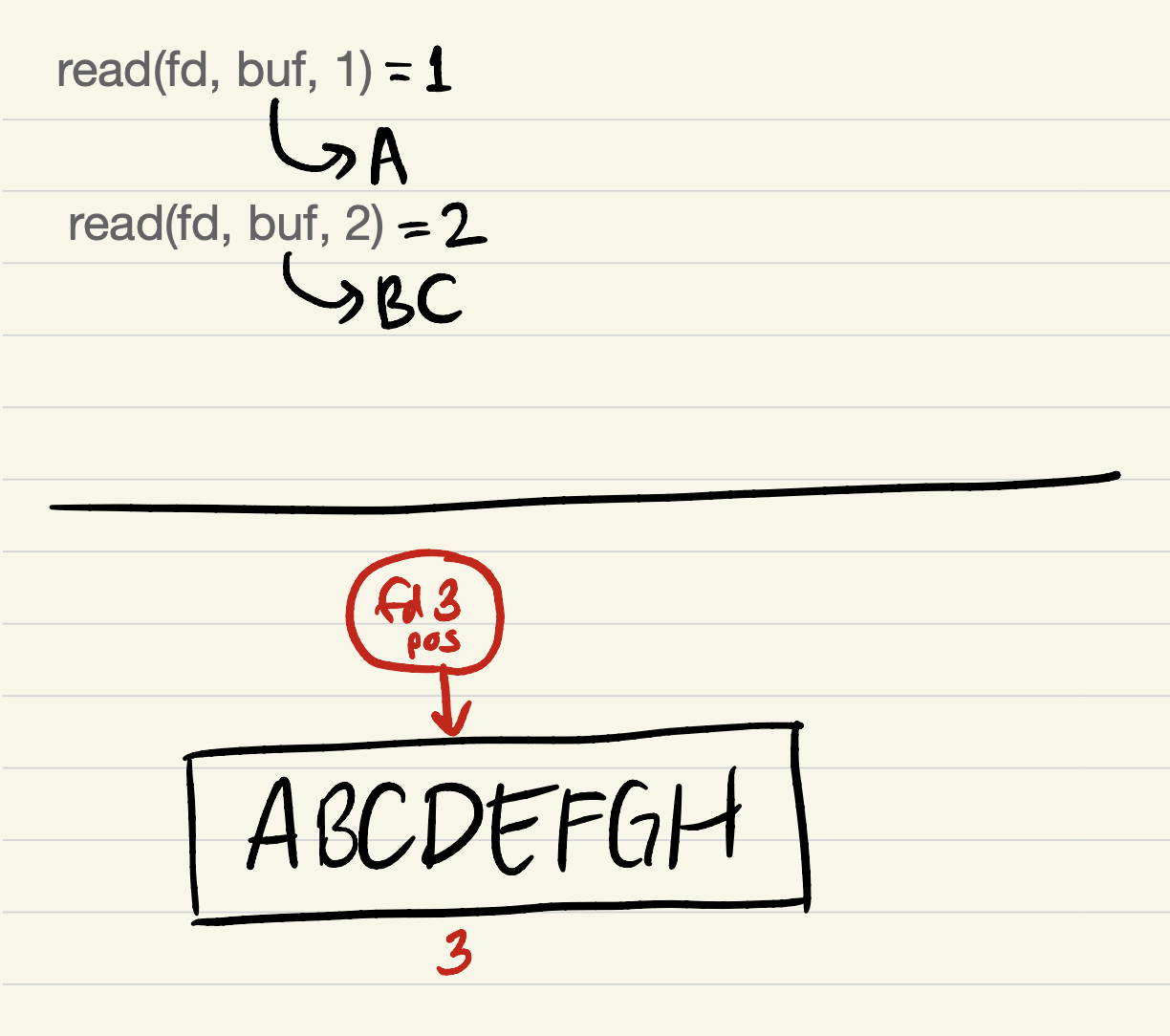
-
After
read(fd, buf, 3):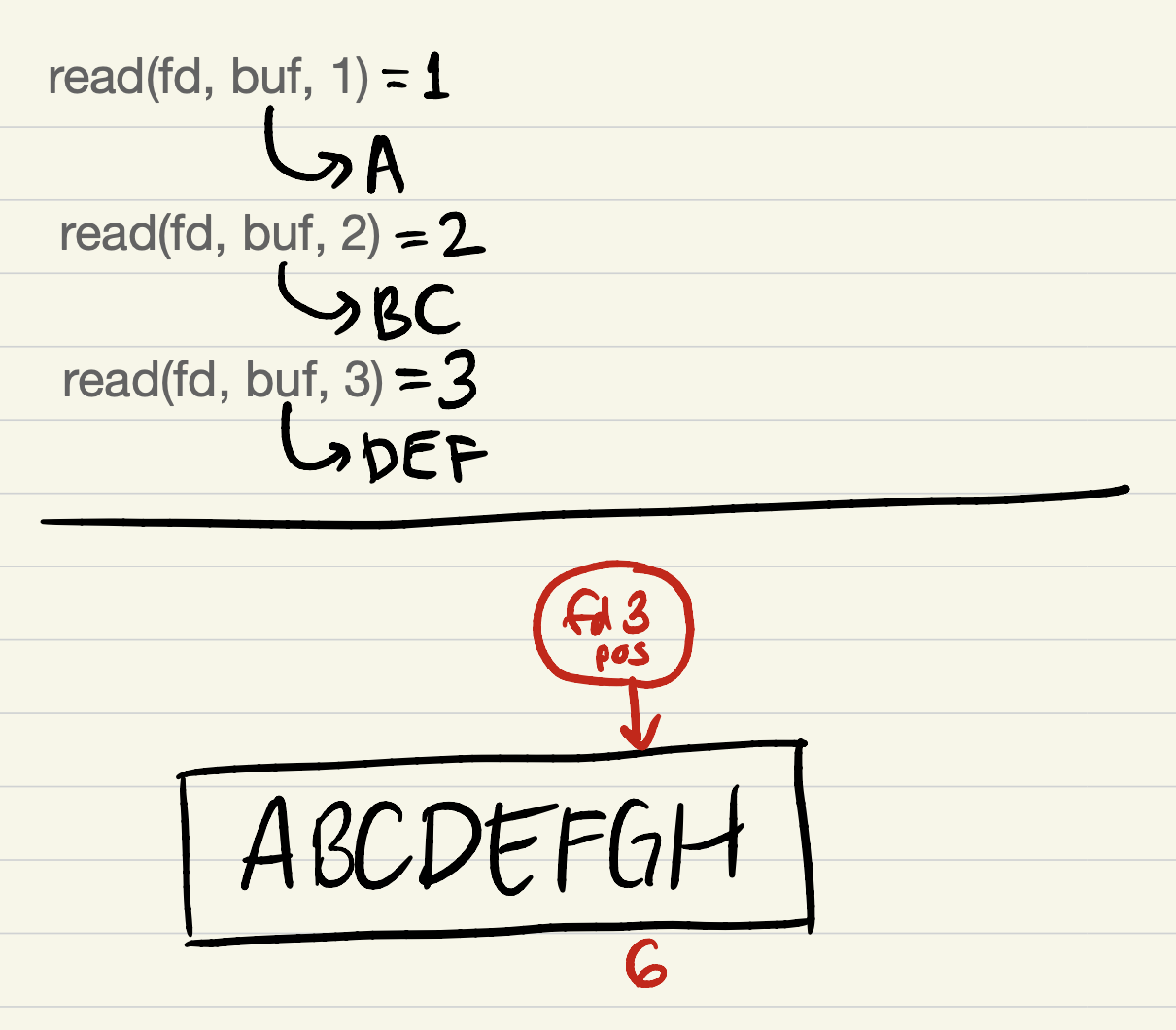
Single-slot cache
A single-slot cache is, as the name suggests, a cache comprising a single slot. The standard I/O cache implemented in most operating systems’ standard I/O libraries has a single slot.
Today in section we’re going to work on a specific single-slot I/O cache design. The purpose is to explain caches and to get you used to thinking in terms of file offsets.
Here’s the representation.
struct io61_fcache {
    int fd;

    // `bufsiz` is the cache block size
    static constexpr off_t bufsize = 4096;
    // Cached data is stored in `cbuf`
    unsigned char cbuf[bufsize];

    // The following “tags” are addresses—file offsets—that describe the cache’s contents.
    // `tag`: File offset of first byte of cached data (0 when file is opened).
    off_t tag;
    // `end_tag`: File offset one past the last byte of cached data (0 when file is opened).
    off_t end_tag;
    // `pos_tag`: Cache position: file offset of the cache.
    // In read caches, this is the file offset of the next character to be read.
    off_t pos_tag;
};
pos_tag refers to the effective file position for users of io61 functions.
That is, the next io61_read or io61_write function should begin at the
file offset represented by pos_tag. Note that this is often different from
the file descriptor’s file position (the value maintained by the kernel)!
EXERCISE. Given the above description of the representation, how can you tell if an
io61_fcacheis empty (contains no cached data)?
EXERCISE. What data invariants might apply to this representation?
Example single-slot cache for reading
To demonstrate how this single-slot cache representation might work, we walk
through the file position example with a small bufsize of
4 for clarity. The goal of a read cache is to produce results equivalent to
a similar series of system calls2, so our io61_reads should return the
same bytes in the same order as the reads above.
-
The cache is initialized to an empty state, with
fd3,bufsiz4, and all oftag,pos_tag, andend_tagequal to 0. When the firstio61_readrequest is passed to the cache, it must fill its buffer with a call toread.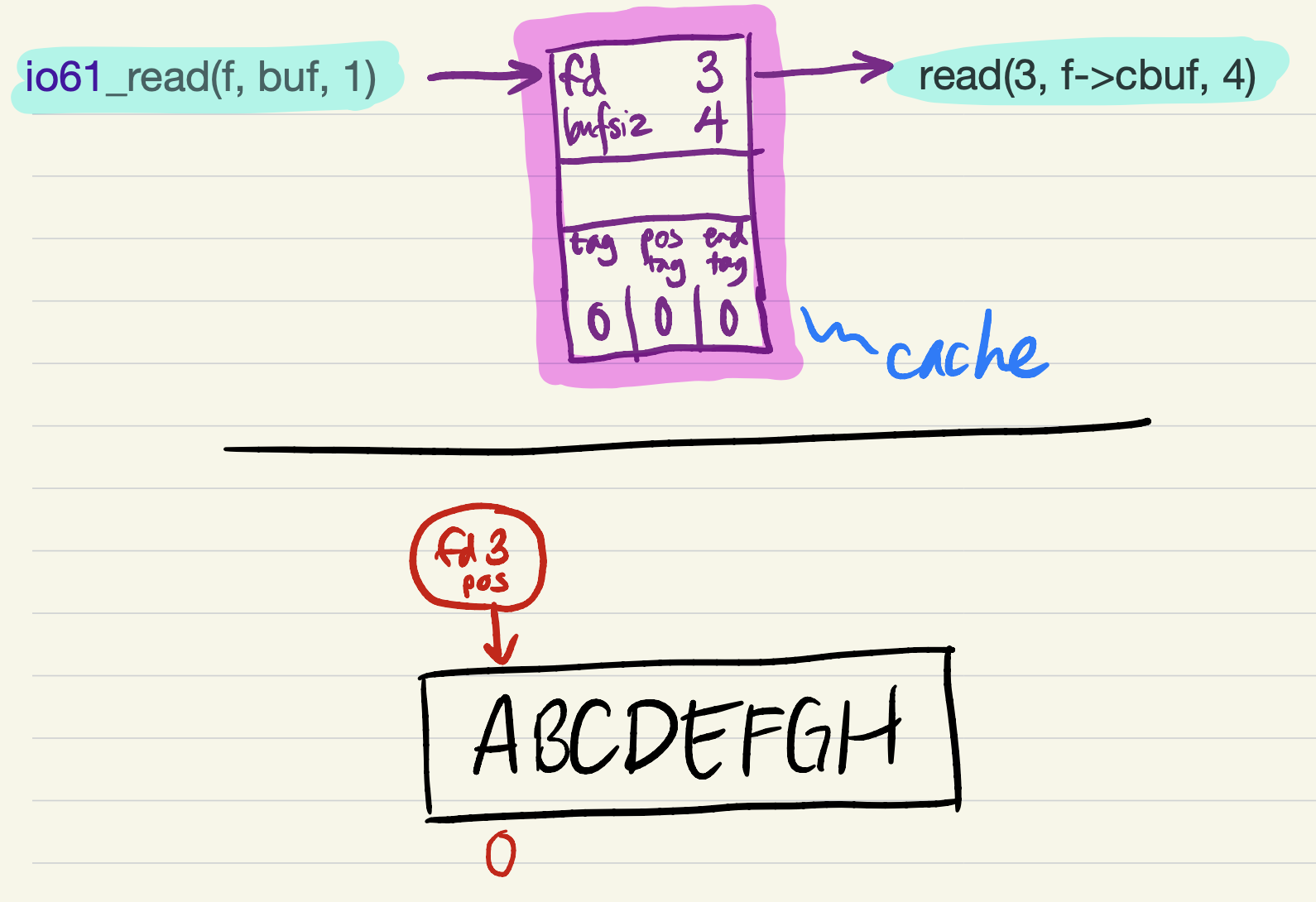
-
The read succeeds, filling all 4 bytes in
cbuf. Theend_tagis updated to indicate that the cache is full (contains 4 bytes of file data).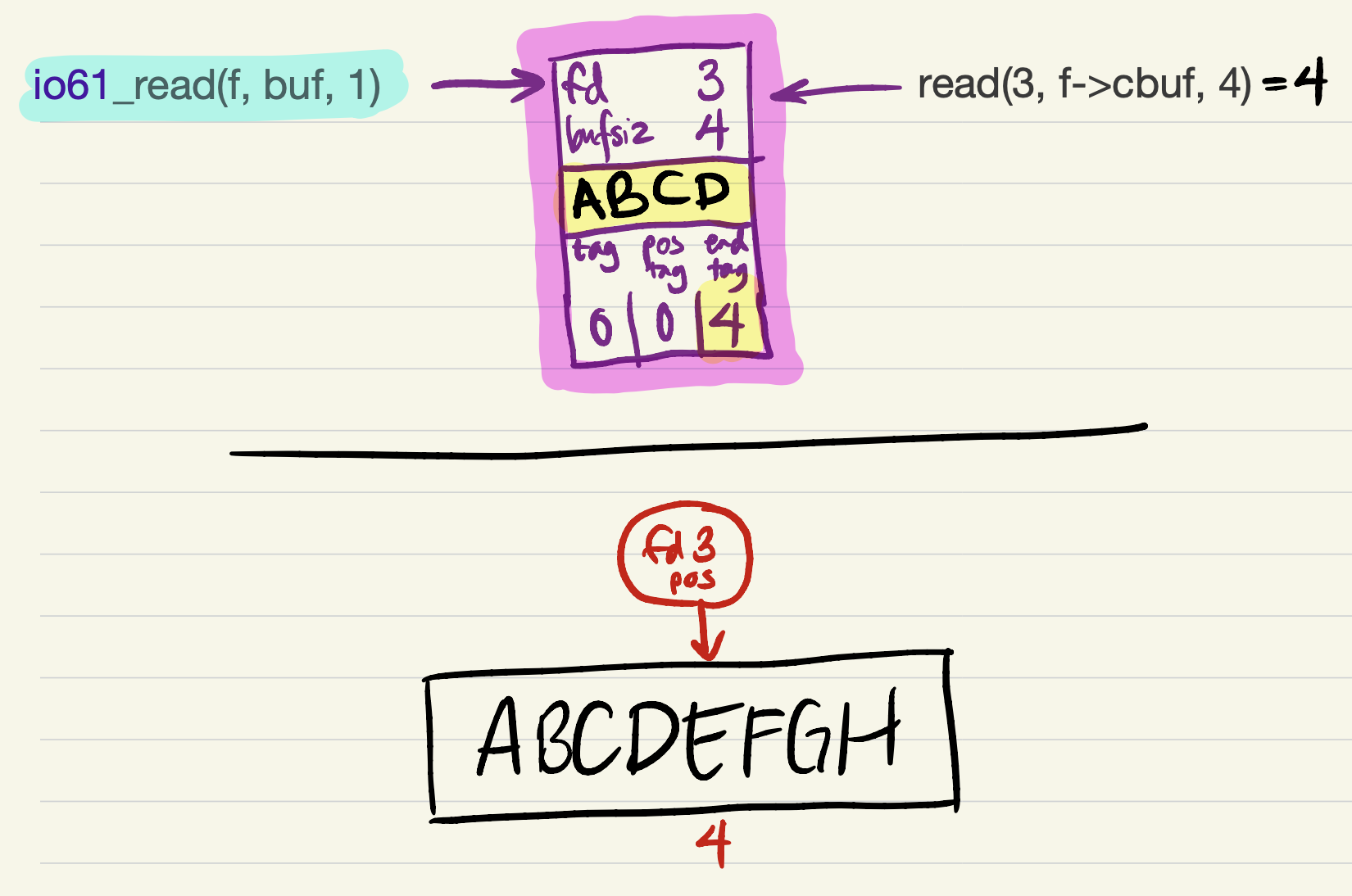
-
Now there is enough data in the cache to fulfill the
io61_readrequest. The request starts from the offset corresponding topos_tag, and must incrementpos_tagaccording to the amount read (just asreadupdates the kernel’s file position by the amount read).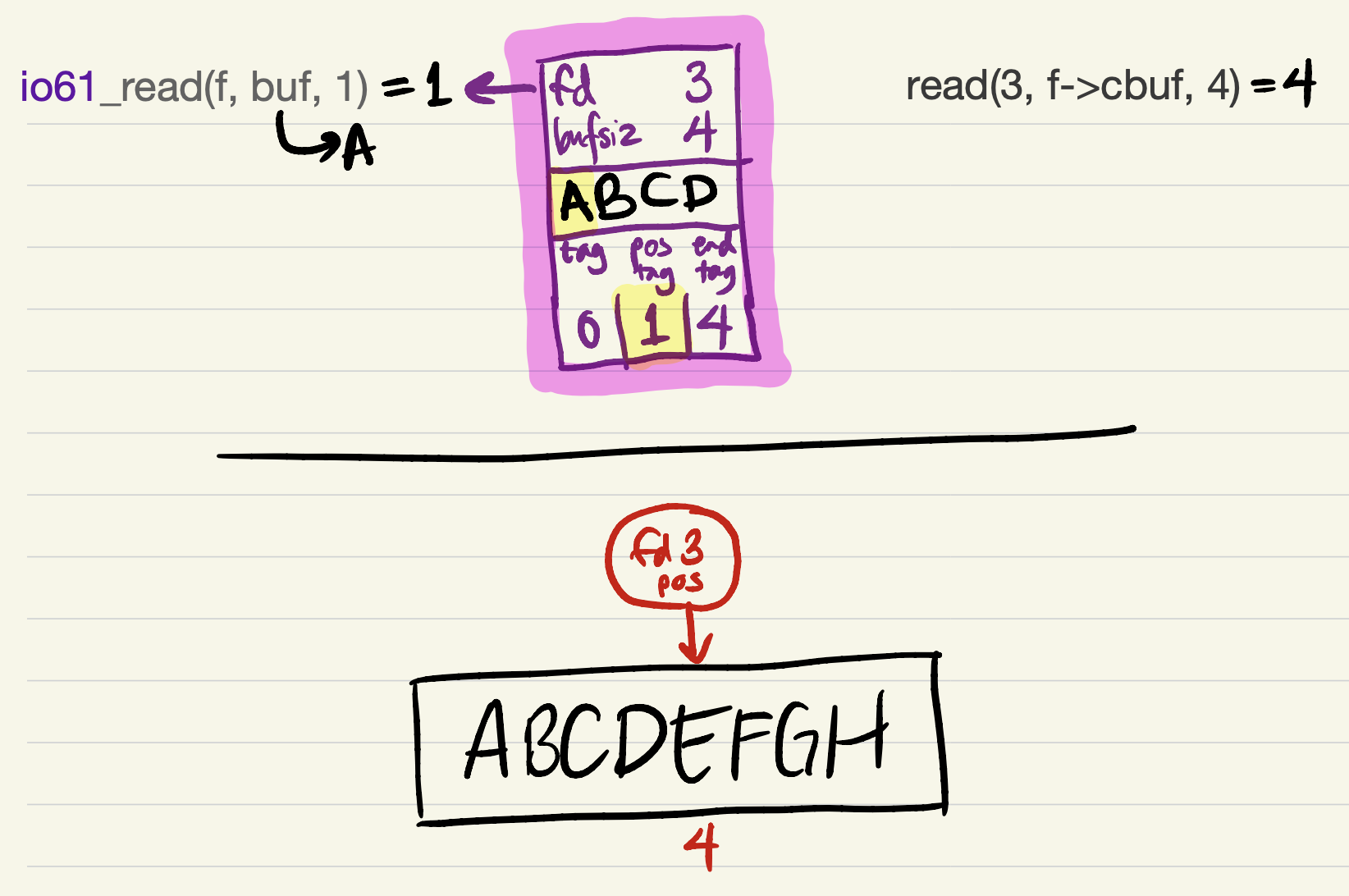
-
The next
io61_readrequest can be satisfied entirely from the cache. No system calls occur, so the kernel’s file position is unchanged.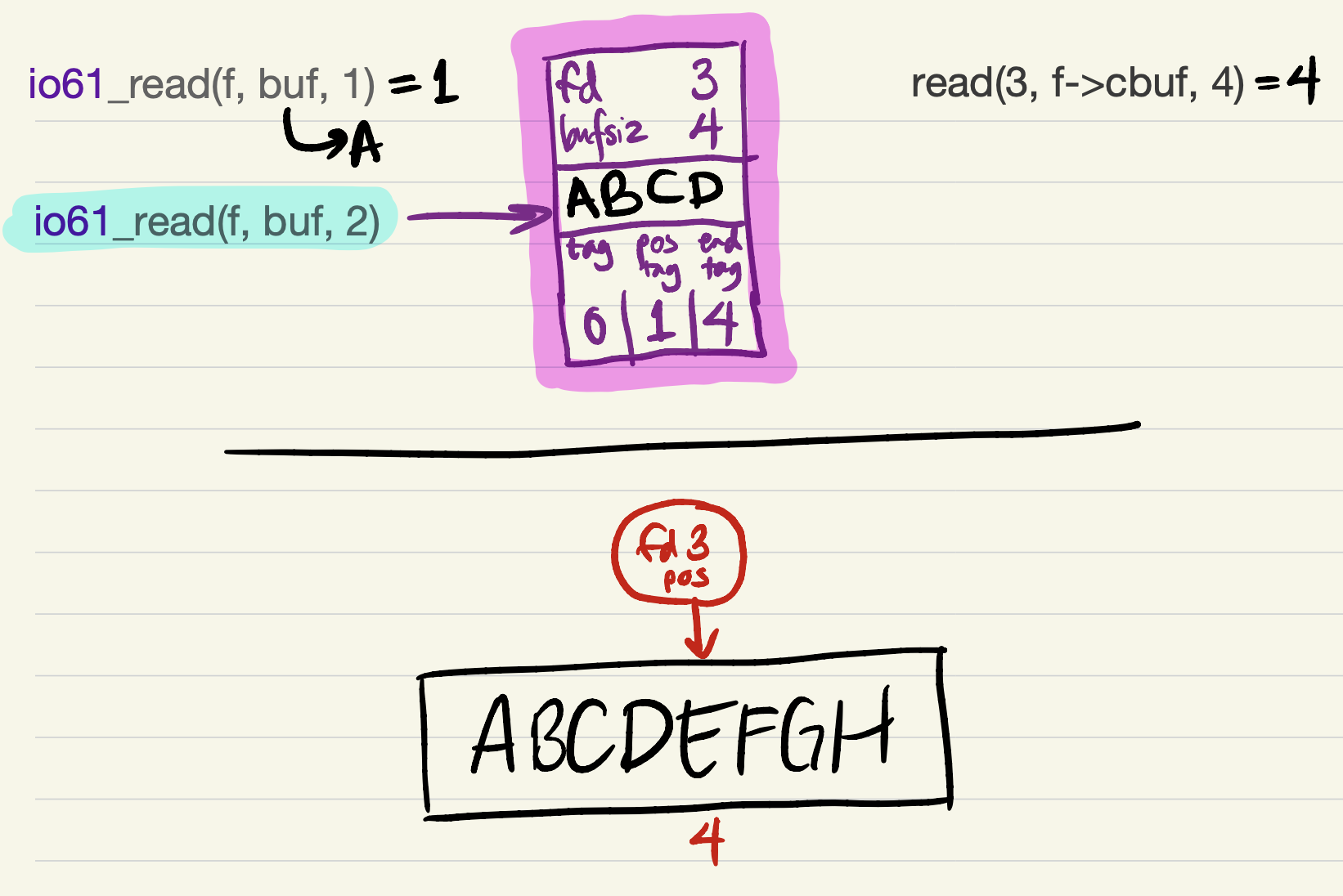
-
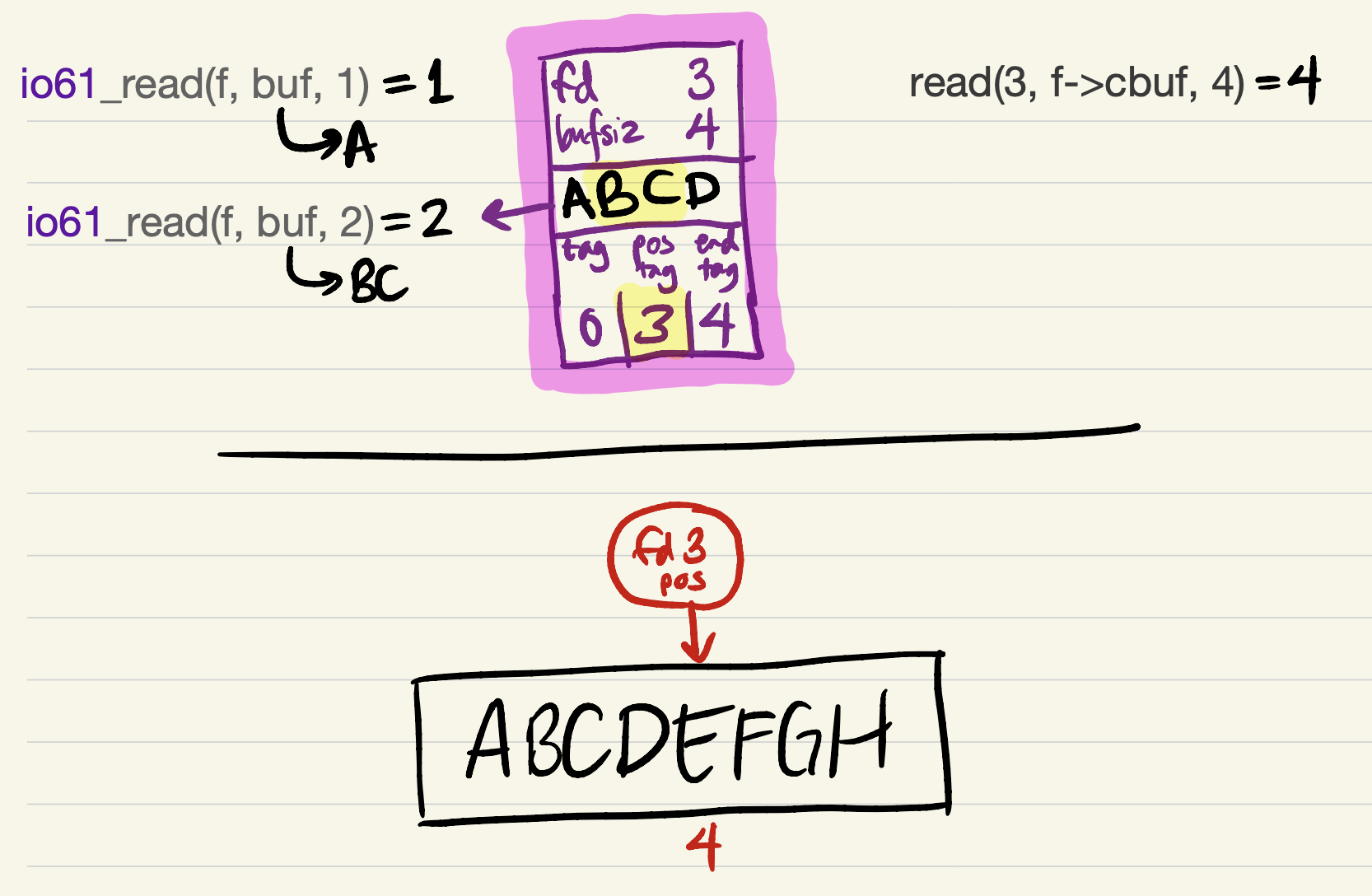
-
The cache contains just 1 byte of data after
pos_tag, so the nextio61_readrequest can only be partially satisfied at first.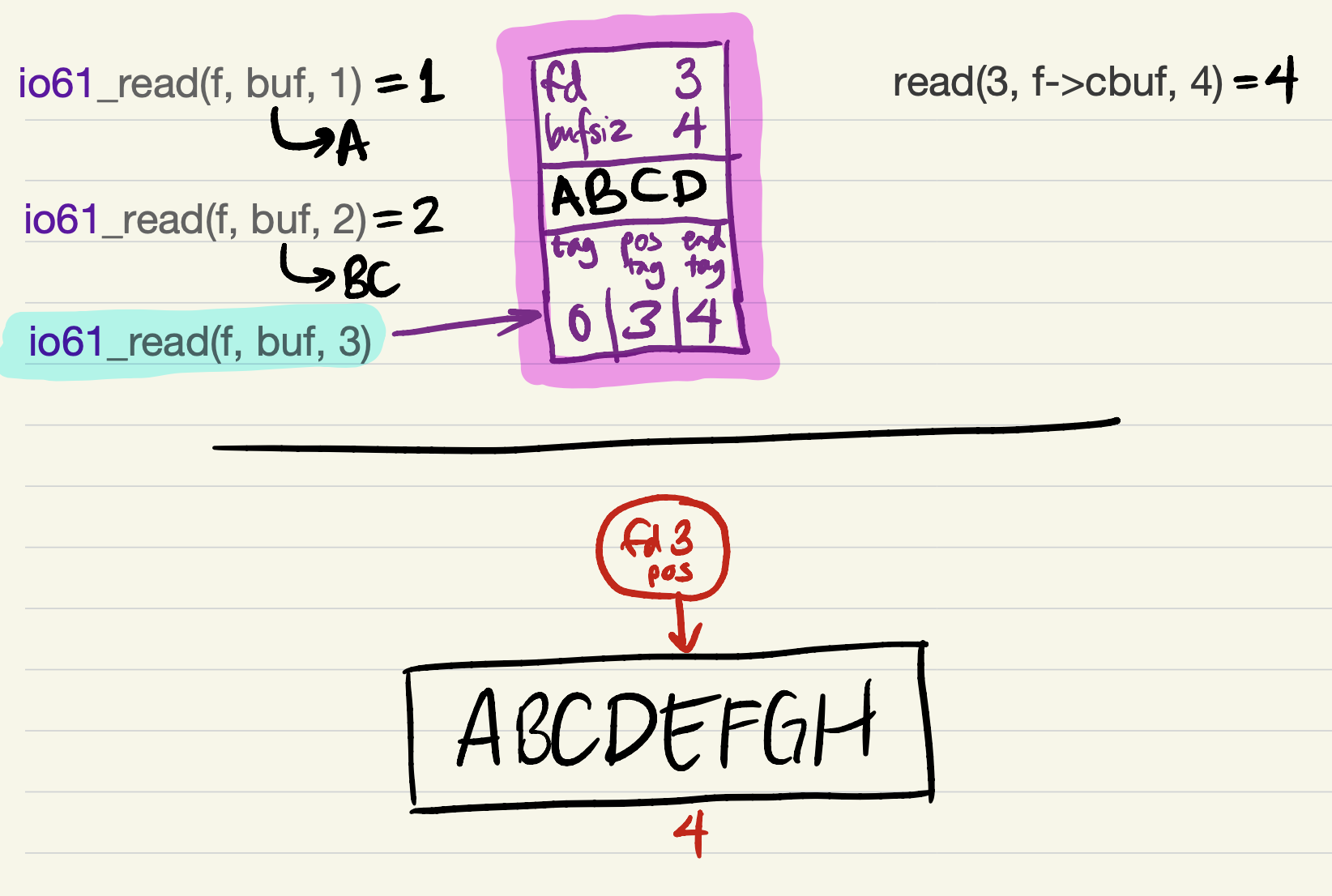
-
Since short reads and writes are allowed by the specifications of
io61_readandio61_write, it would be safe forio61_readto return now, with a short read of 1 byte! This still counts as equivalent to the version with system calls, because the same bytes are being returned in the same order.3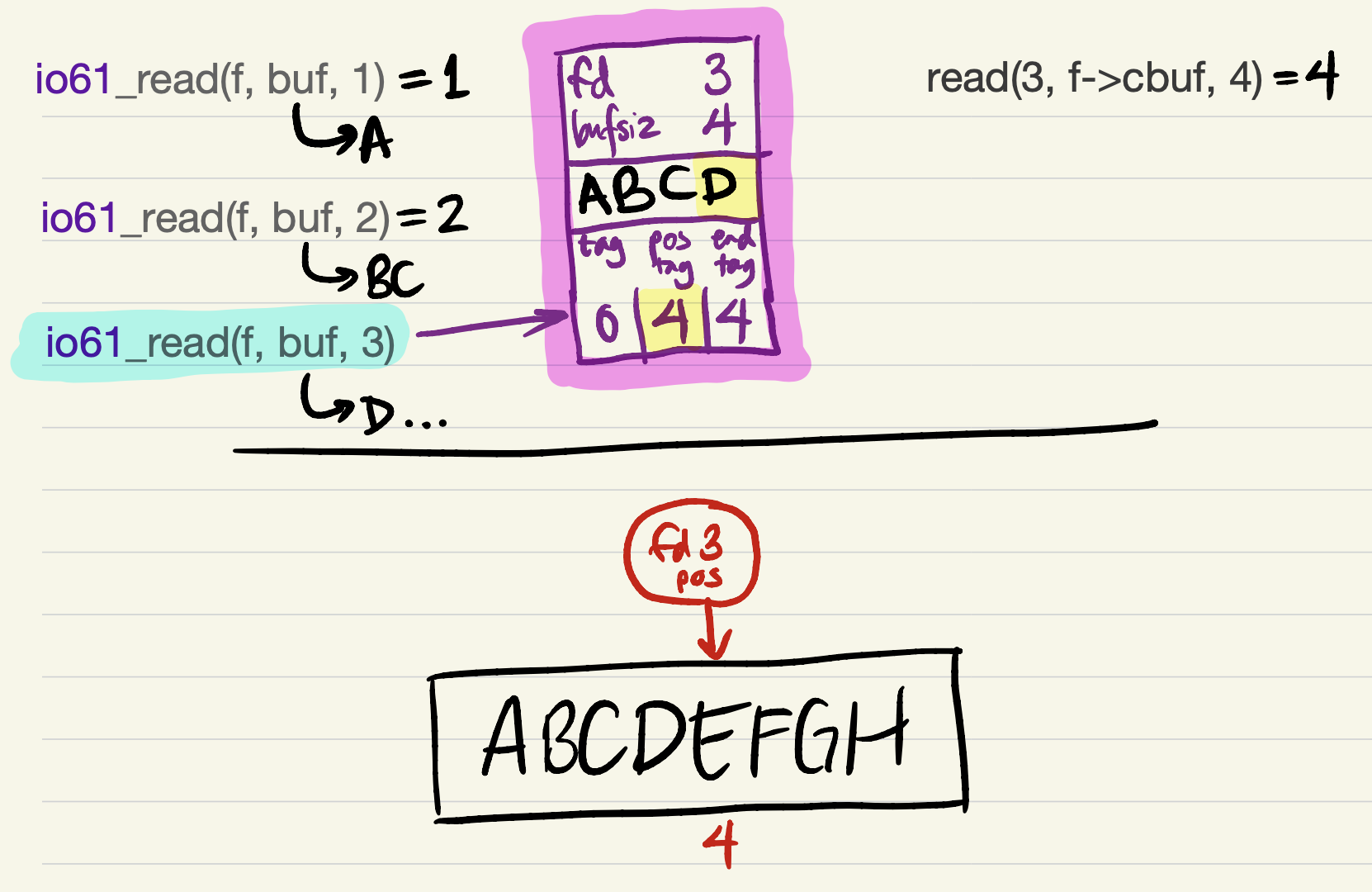
-
But it’s probably better to try to return as much data as the user requested. This requires refilling the cache. We update
tagbefore refilling the cache (because the offset of the first cached byte would equal the file position);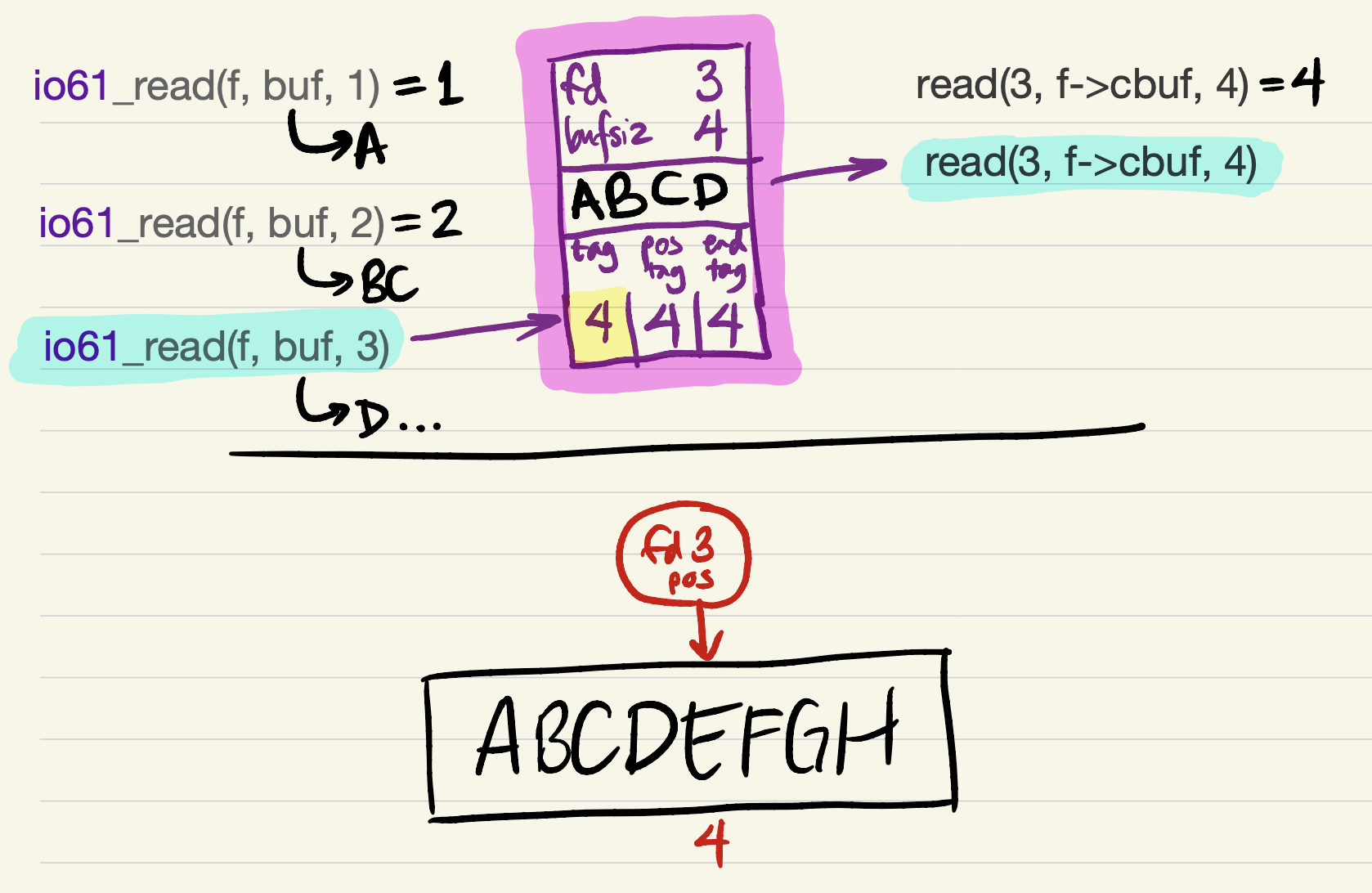
-
and then, after the
readsucceeds, updateend_tag(because the cache is filled).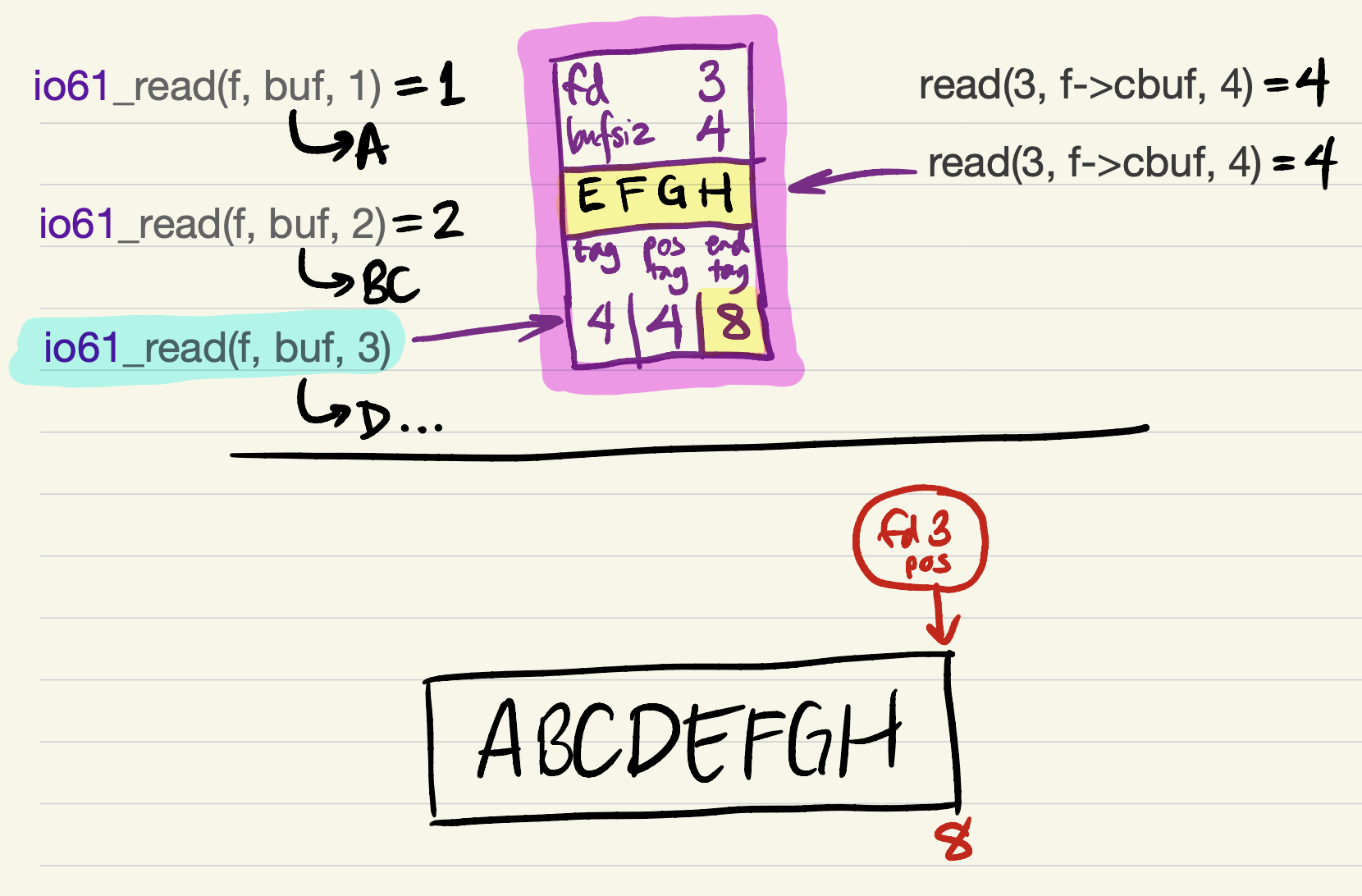
-
Finally, the last 2 bytes can be returned to the user.
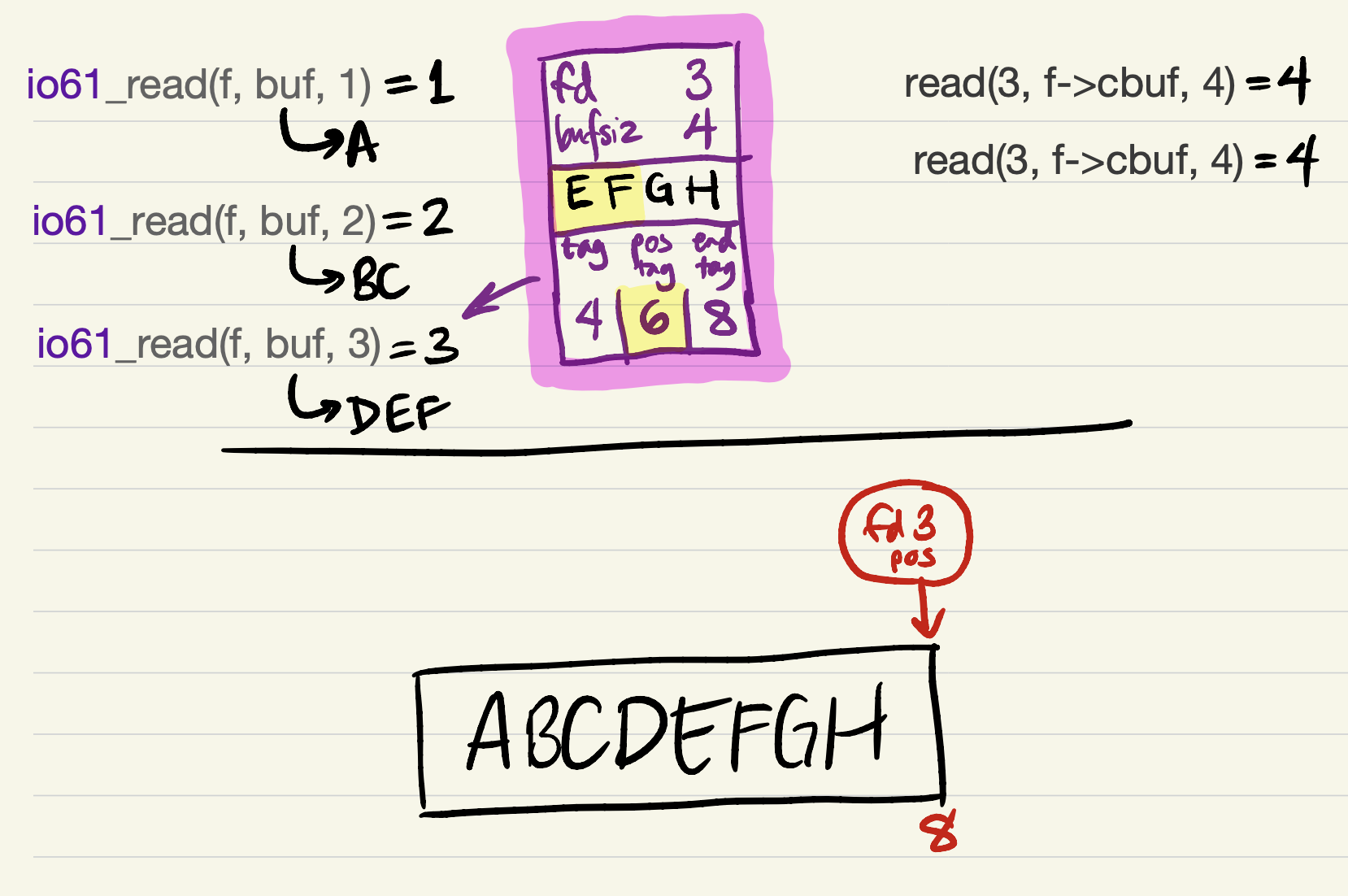
EXERCISE. Having worked through an example, can you add any more data invariants for this cache representation?
Fill read cache
As you implement, remember the invariants: we find the invariants and representation extremely good guidance for a correct implementation.
EXERCISE SS1. Implement this function, which should fill the cache with data read from the file. You will make a
readsystem call.void io61_fill(io61_fcache* f) { // Empty the cache entry, then fill it with new data. // The new data is taken from the file starting at file offset `end_tag` // (which equals the file position). // The cache position equals the first character read. // Only called for read caches. // Check invariants. assert(f->tag <= f->pos_tag && f->pos_tag <= f->end_tag); assert(f->end_tag - f->pos_tag <= f->bufsize); // Reset the cache to empty. f->tag = f->pos_tag = f->end_tag; // Recheck invariants (good practice!). assert(f->tag <= f->pos_tag && f->pos_tag <= f->end_tag); assert(f->end_tag - f->pos_tag <= f->bufsize); }SUB-EXERCISE. Which cache tags will need to change in this function, and by how much?
SUB-EXERCISE. Do you need to use
memcpyin this function?
Read from read cache (simple version)
EXERCISE SS2. Implement
io61_read, assuming that the desired data is entirely contained within the current cache slot.ssize_t io61_read(io61_fcache* f, unsigned char* buf, size_t sz) { // Check invariants. assert(f->tag <= f->pos_tag && f->pos_tag <= f->end_tag); assert(f->end_tag - f->pos_tag <= f->bufsize); // The desired data is guaranteed to lie within this cache slot. assert(sz <= f->bufsize && f->pos_tag + sz <= f->end_tag); }SUB-EXERCISE. Which cache tags will need to change in this function, and by how much?
SUB-EXERCISE. Do you need to use
memcpyin this function?
Read from read cache (full version)
EXERCISE SS3. Implement
io61_readwithout that assumption. You will need to callio61_fill, and will use a loop. You may assume that no call toreadever returns an error.Our tests do not check whether your IO61 library handles errors correctly. This means that you may assume that no
readandwritesystem call returns a permanent error. But the best implementations will handle errors gracefully: if areadsystem call returns a permanent error, thenio61_readshould return -1. (What to do with restartable errors is up to you, but most I/O libraries retry on encounteringEINTR.)ssize_t io61_read(io61_fcache* f, unsigned char* buf, size_t sz) { // Check invariants. assert(f->tag <= f->pos_tag && f->pos_tag <= f->end_tag); assert(f->end_tag - f->pos_tag <= f->bufsize); }SUB-EXERCISE. Which cache tags will need to change in this function, and by how much?
SUB-EXERCISE. Do you need to use
memcpyin this function?
Exercises
All exercises assume a 64-bit x86-64 architecture unless otherwise stated.
The main subjects of these exercises are:
- IO-19: File system calls.
- IO-20: Types of cache.
- IO-4: Reading straces.
- IO-17: Reference strings and hit rates.
- IO-14: Single-slot cache implementation.
IO-19. File system calls
QUESTION IO-19A. A program makes these system calls:
int fd = open("f.txt", O_WRONLY | O_CREAT | O_TRUNC);
ssize_t nw = write(fd, "CS121 is awesome!", 17); // returned 17
What following series of system calls would ensure that, after all system
calls complete, the file f.txt contains the text “CS 61 is terrible”
(without the quotation marks)? Minimize the number of bytes written.
QUESTION IO-19B. Which of the following file access patterns might have similar
output from the strace utility? List all that apply or say “none.”
- Sequential byte writes using stdio
- Sequential byte writes using
mmap - Sequential byte writes using system calls
QUESTION IO-19C. Which of the following file access patterns might have similar
output from the strace utility? List all that apply or say “none.”
- Sequential byte writes using stdio
- Sequential block writes using stdio
- Sequential byte writes using system calls
- Sequential block writes using system calls
QUESTION IO-19D. Which of the following file access patterns might have similar
output from the strace utility? List all that apply or say “none.”
- Reverse-sequential byte writes using stdio
- Reverse-sequential block writes using stdio
- Reverse-sequential byte writes using system calls
- Reverse-sequential block writes using system calls
IO-20. Caches Big, Fast, and Cheap
QUESTION IO-20A. We discussed several kinds of computer storage in class, including:
- Drives (disks and SSDs)
- primary Memory
- processor Cache memory
- Registers
Put those storage technologies in order by latency, slowest first. (An answer might be “DMCR”.)
QUESTION IO-20B. Put those storage technologies in order by cost per byte, cheapest first.
QUESTION IO-20C. Put those storage technologies in order by capacity in bytes on a typical computer, smallest first.
QUESTION IO-20D. Which storage technology serves as the underlying storage for each of the following caches? If unsure, explain briefly.
- Buffer cache
- Stdio cache
- Processor cache
QUESTION IO-20E. True or false? Given a cache with two or more blocks, implementing it as a fully associative cache would always produce as good or better hit rates than a direct-mapped implementation.
QUESTION IO-20F. True or false? Prefetching bytes from a file on disk into the buffer cache can cause the buffer cache to become incoherent.
IO-4. I/O caching and strace
Elif Batuman is investigating several program executables left behind by her
ex-roommate Fyodor. She knows these executables perform byte-at-a-time
I/O, but she’s not sure what kinds of caches they use. To find out, she runs
each executable under strace in the following way:
strace -o strace.txt ./EXECUTABLE files/text1meg.txt > files/out.txt
Help her figure out properties of these programs based on their system call traces.
QUESTION IO-4A. Program ./mysterya:
open("files/text1meg.txt", O_RDONLY)    = 3
brk(0)                                  = 0x8193000
brk(0x81b5000)                          = 0x81b5000
read(3, "A", 1)                         = 1
write(1, "A", 1)                        = 1
read(3, "\n", 1)                        = 1
write(1, "\n", 1)                       = 1
read(3, "A", 1)                         = 1
write(1, "A", 1)                        = 1
read(3, "'", 1)                         = 1
write(1, "'", 1)                        = 1
read(3, "s", 1)                         = 1
write(1, "s", 1)                        = 1
...
List at least one option in each column.
|
|
|
|
QUESTION IO-4B. Program ./mysteryb:
open("files/text1meg.txt", O_RDONLY)    = 3
brk(0)                                  = 0x96c5000
brk(0x96e6000)                          = 0x96e6000
read(3, "A\nA's\nAA's\nAB's\nABM's\nAC's\nACTH'"..., 2048) = 2048
write(1, "A\nA's\nAA's\nAB's\nABM's\nAC's\nACTH'"..., 2048) = 2048
read(3, "kad\nAkron\nAkron's\nAl\nAl's\nAla\nAl"..., 2048) = 2048
write(1, "kad\nAkron\nAkron's\nAl\nAl's\nAla\nAl"..., 2048) = 2048
...
List at least one option in each column.
|
|
|
|
QUESTION IO-4C. Program ./mysteryc:
open("files/text1meg.txt", O_RDONLY)    = 3
brk(0)                                  = 0x9064000
brk(0x9085000)                          = 0x9085000
fstat64(3, {st_mode=S_IFREG|0664, st_size=1048576, ...}) = 0
lseek(3, 1046528, SEEK_SET)             = 1046528
read(3, "ingau\nRheingau's\nRhenish\nRhianno"..., 2048) = 2048
write(1, "oR\ntlevesooR\ns'yenooR\nyenooR\ns't"..., 2048) = 2048
lseek(3, 1044480, SEEK_SET)             = 1044480
read(3, "Quinton\nQuinton's\nQuirinal\nQuisl"..., 2048) = 2048
write(1, "ehR\neehR\naehR\ns'hR\nhR\nsdlonyeR\ns"..., 2048) = 2048
lseek(3, 1042432, SEEK_SET)             = 1042432
read(3, "emyslid's\nPrensa\nPrensa's\nPrenti"..., 2048) = 2048
write(1, "\ns'nailitniuQ\nnailitniuQ\nnniuQ\ns"..., 2048) = 2048
lseek(3, 1040384, SEEK_SET)             = 1040384
read(3, "Pindar's\nPinkerton\nPinocchio\nPin"..., 2048) = 2048
write(1, "rP\ndilsymerP\ns'regnimerP\nregnime"..., 2048) = 2048
...
List at least one option in each column.
|
|
|
|
QUESTION IO-4D. Program ./mysteryd:
open("files/text1meg.txt", O_RDONLY)    = 3
brk(0)                                  = 0x9a0e000
brk(0x9a2f000)                          = 0x9a2f000
fstat64(3, {st_mode=S_IFREG|0664, st_size=1048576, ...}) = 0
lseek(3, 1048575, SEEK_SET)             = 1048575
read(3, "o", 2048)                      = 1
lseek(3, 1048574, SEEK_SET)             = 1048574
read(3, "Ro", 2048)                     = 2
lseek(3, 1048573, SEEK_SET)             = 1048573
read(3, "\nRo", 2048)                   = 3
...
lseek(3, 1046528, SEEK_SET)             = 1046528
read(3, "ingau\nRheingau's\nRhenish\nRhianno"..., 2048) = 2048
write(1, "oR\ntlevesooR\ns'yenooR\nyenooR\ns't"..., 2048) = 2048
lseek(3, 1046527, SEEK_SET)             = 1046527
read(3, "eingau\nRheingau's\nRhenish\nRhiann"..., 2048) = 2048
lseek(3, 1046526, SEEK_SET)             = 1046526
read(3, "heingau\nRheingau's\nRhenish\nRhian"..., 2048) = 2048
...
List at least one option in each column.
|
|
|
|
QUESTION IO-4E. Program ./mysterye:
open("files/text1meg.txt", O_RDONLY)    = 3
brk(0)                                  = 0x93e5000
brk(0x9407000)                          = 0x9407000
read(3, "A", 1)                         = 1
read(3, "\n", 1)                        = 1
read(3, "A", 1)                         = 1
...
read(3, "A", 1)                         = 1
read(3, "l", 1)                         = 1
write(1, "A\nA's\nAA's\nAB's\nABM's\nAC's\nACTH'"..., 1024) = 1024
read(3, "t", 1)                         = 1
read(3, "o", 1)                         = 1
read(3, "n", 1)                         = 1
...
List at least one option in each column.
|
|
|
|
QUESTION IO-4F. Program ./mysteryf:
open("files/text1meg.txt", O_RDONLY)    = 3
brk(0)                                  = 0x9281000
brk(0x92a3000)                          = 0x92a3000
read(3, "A\nA's\nAA's\nAB's\nABM's\nAC's\nACTH'"..., 4096) = 4096
write(1, "A", 1)                        = 1
write(1, "\n", 1)                       = 1
write(1, "A", 1)                        = 1
...
write(1, "A", 1)                        = 1
write(1, "l", 1)                        = 1
read(3, "ton's\nAludra\nAludra's\nAlva\nAlvar"..., 4096) = 4096
write(1, "t", 1)                        = 1
write(1, "o", 1)                        = 1
write(1, "n", 1)                        = 1
...
List at least one option in each column.
|
|
|
|
IO-17. Reference strings and hit rates
QUESTION IO-17A. Write a purely-sequential reference string containing at least five accesses.
QUESTION IO-17B. What is the hit rate for this reference string? Tell us the eviction algorithm and number of slots you’ve chosen.
Parts C and D concern this ten-element reference string:
1 2 1 2 3 4 1 5 1 1
We consider executing this reference string starting with different cache contents.
QUESTION IO-17C. A three-slot LRU cache processes this reference string and observes a 70% hit rate. What are the initial contents of the cache?
QUESTION IO-17D. A three-slot FIFO cache with initial contents 4, 1, and 2 (in slots A, B, and C, respectively) processes the reference string and observes a 60% hit rate. Which slot was next up for eviction when the reference string began? (Assume the slots were initially filled in alphabetical order.)
The eviction algorithms we saw in class are entirely reactive: they only insert a block when that block is referenced. This limits how well the cache can perform. A read cache can also be proactive by inserting blocks before they’re needed, possibly speeding up later accesses. This is the essence of prefetching.
In a proactive caching model, the cache can evict and load two or more blocks per access in the reference string. A prefetching policy decides which additional, non-accessed blocks to load.
QUESTION IO-17E. Describe an access pattern for which the following prefetching policy would be effective: When filling a cache with block A, also load block A+1 into another slot.
QUESTION IO-17F. Write a reference string and name an eviction policy and/or cache size for which this prefetching policy would be less effective (have a lower hit rate) than no prefetching at all.
IO-14. Cache code
Several famous musicians have just started working on the standard I/O problem set. They share the following code for their read-only, sequential, single-slot cache:
struct io61_file {
    int fd;
    unsigned char buf[4096];
    size_t pos;    // position of next character to read in `buf`
    size_t sz;     // number of valid characters in `buf`
};

int io61_readc(io61_file* f) {
    if (f->pos >= f->sz) {
        f->pos = f->sz = 0;
        ssize_t nr = read(f->fd, f->buf, sizeof(f->buf));
        if (nr <= 0) {
            f->sz = 0;
            return -1;
        } else {
            f->sz = nr;
        }
    }
    int ch = f->buf[f->pos];
    ++f->pos;
    return ch;
}
But they have different io61_read implementations. Donald
(Lambert)’s is:
ssize_t io61_read(io61_file* f, char* buf, size_t sz) {
    return read(f->fd, buf, sz);
}
Solange (Knowles)’s is:
ssize_t io61_read(io61_file* f, char* buf, size_t sz) {
    for (size_t pos = 0; pos < sz; ++pos, ++buf) {
        *buf = io61_readc(f);
    }
    return sz;
}
Caroline (Shaw)’s is:
ssize_t io61_read(io61_file* f, char* buf, size_t sz) {
    if (f->pos >= f->sz) {
        return read(f->fd, buf, sz);
    } else {
        int ch = io61_readc(f);
        if (ch < 0) {
            return 0;
        }
        *buf = ch;
        return io61_read(f, buf + 1, sz - 1) + 1;
    }
}
You are testing each of these musicians’ codes by executing a sequence
of io61_readc and/or io61_read calls on an input file and
printing the resulting characters to standard output. There are no
seeks, and your test programs print until end of file, so your tests’
output should equal the input file’s contents.
You should assume for these questions that no read system call
ever returns -1.
QUESTION IO-14A. Describe an access pattern—that is, a sequence of
io61_readc and/or io61_read calls (with lengths)—for which
Donald’s code can return incorrect data.
QUESTION IO-14B. Which of these musicians’ codes can generate an output file with incorrect length?
QUESTION IO-14C. Give a sequence of io61 calls for which Solange’s code will outperform Donald’s, or vice versa, and explain briefly.
QUESTION IO-14D. Suggest a small change (≤10 characters) to Caroline’s code that could make it perform at least as well as both Solange’s and Donald’s codes on all access patterns. Explain briefly.
-
File descriptors that represent infinite streams do not have file positions. ↩︎
-
This holds exactly for files that aren’t being written concurrently. If there are concurrent writes, non-coherent caches, such as stdio caches, may return stale data. ↩︎
-
0 always means end-of-file, so it is not allowed to return 0 as a “short read” (instead the system call will block, or will return −1 with error code
EINTRorEAGAIN). ↩︎